
A Brook o’ Ware
My Orcadian column for June

Back home earlier in the spring, the wind got up on the night before full moon, shaking the windows of the caravan and bringing powerful rolling waves to the west coast.
In the morning, the beach at Skaill has changed, with a large amount of stormcast seaweed washed up in long ragged mounds at the high water line. My older son, seven, and I are dropped off to walk from the bay up along the coast to the farm, rare time for just the two of us.
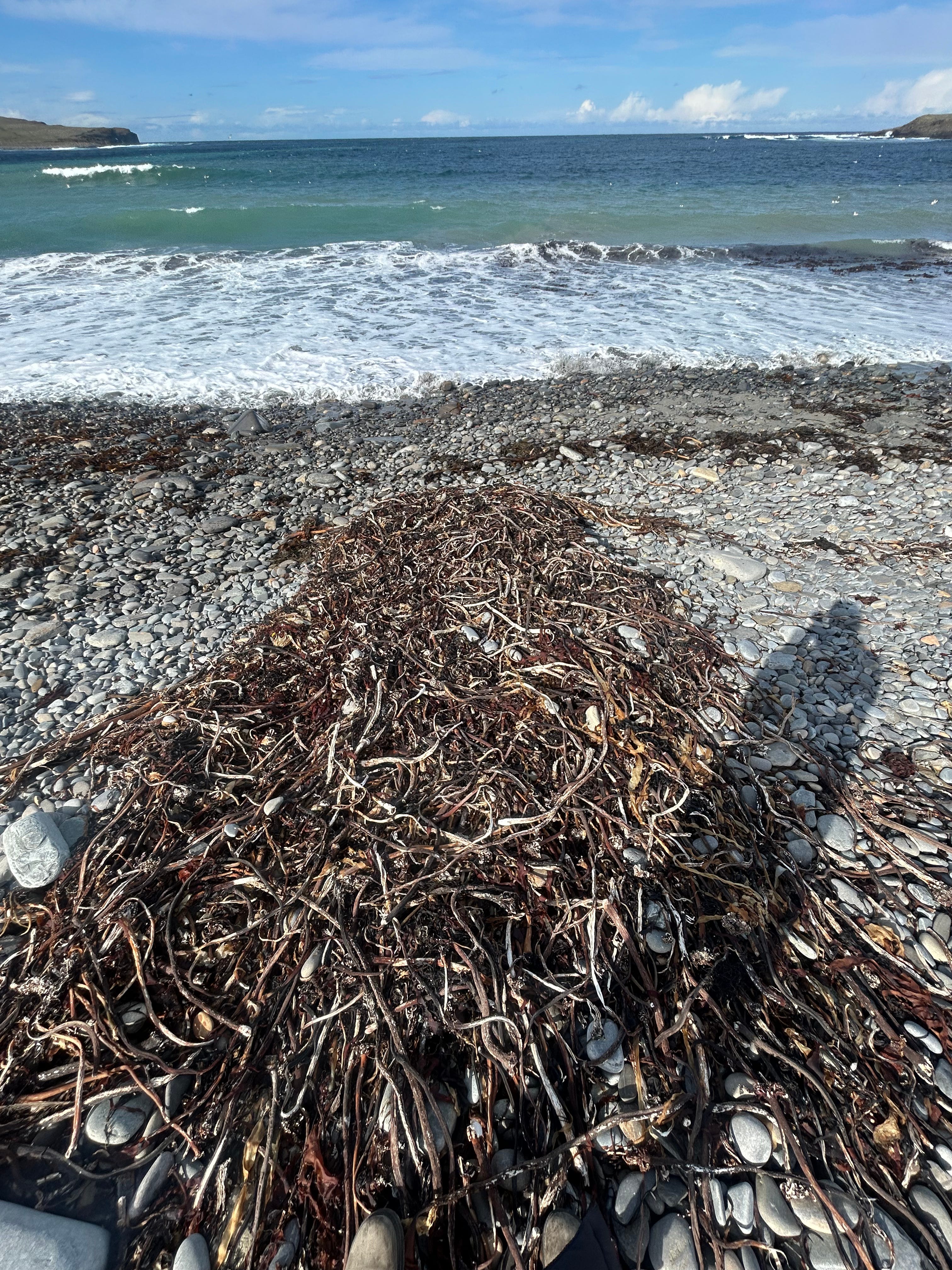
We smell the decomposing seaweed as soon as we open the car door. The gulls, herring and black headed, are excited, flocking around the seaweed bonanza. At the top of the beach, I hand my son the binoculars and help him to focus on the birds.
Different types of seaweed wash up in different places, a grading system. At one place it’s mainly lengths of wracks: bladder, knotted, spiral, serrated, known in Orkney as ‘tang’. In another part of the beach, a huge pile of kelp stipes - the stick-like stalks of tangle, from black to russet to translucent - have been broken off by the strong waves and currents and left by the high spring tides. The seaweeds which grow below the low water mark, constantly submerged - the kelps - are known as ‘ware’, particularly when broken off and washed up like this. Confusingly, one of the kelps is also known as ‘tangle’. The local phrase for seaweeds collectively is ‘Tang and Ware’.
As we walk down toward a heap of stormcast seaweed - a “brook o’ ware” - we can hear it humming with insects. A little warmth from the sun has brought kelp flies and other invertebrates to the ware which in turn brings birds. Hundreds of waders - mainly turnstones and redshanks today - shift across the sand nervously, searching for food among the seaweed. Rock pipits, which live by the sea year-round eating small marine molluscs, sand hoppers and flies, are known locally as ‘tangle sparrows’ because of this feeding behaviour. We watch a pair of pied wagtails and newly arrived sand martins which my son recognises from our time on Papay.
Predator birds such as merlins are then attracted to the smaller birds. The larvae of the kelp flies are washed back out to sea where they feed the fish, which in turn feed the seals, which then feed the orca. It’s a perfect food web. The rotting piles of seaweed also have a role in reducing coastal erosion - forming cushioning between the rocks and the action of the sea.
As we continue up the coast, my boy clambers around the same shoreline where I played as a child, familiar sloping black rocks and little geos. In Yorkshire, the boys usually pick up a special stick from the woods to take home. Here, it’s a length of tangle.
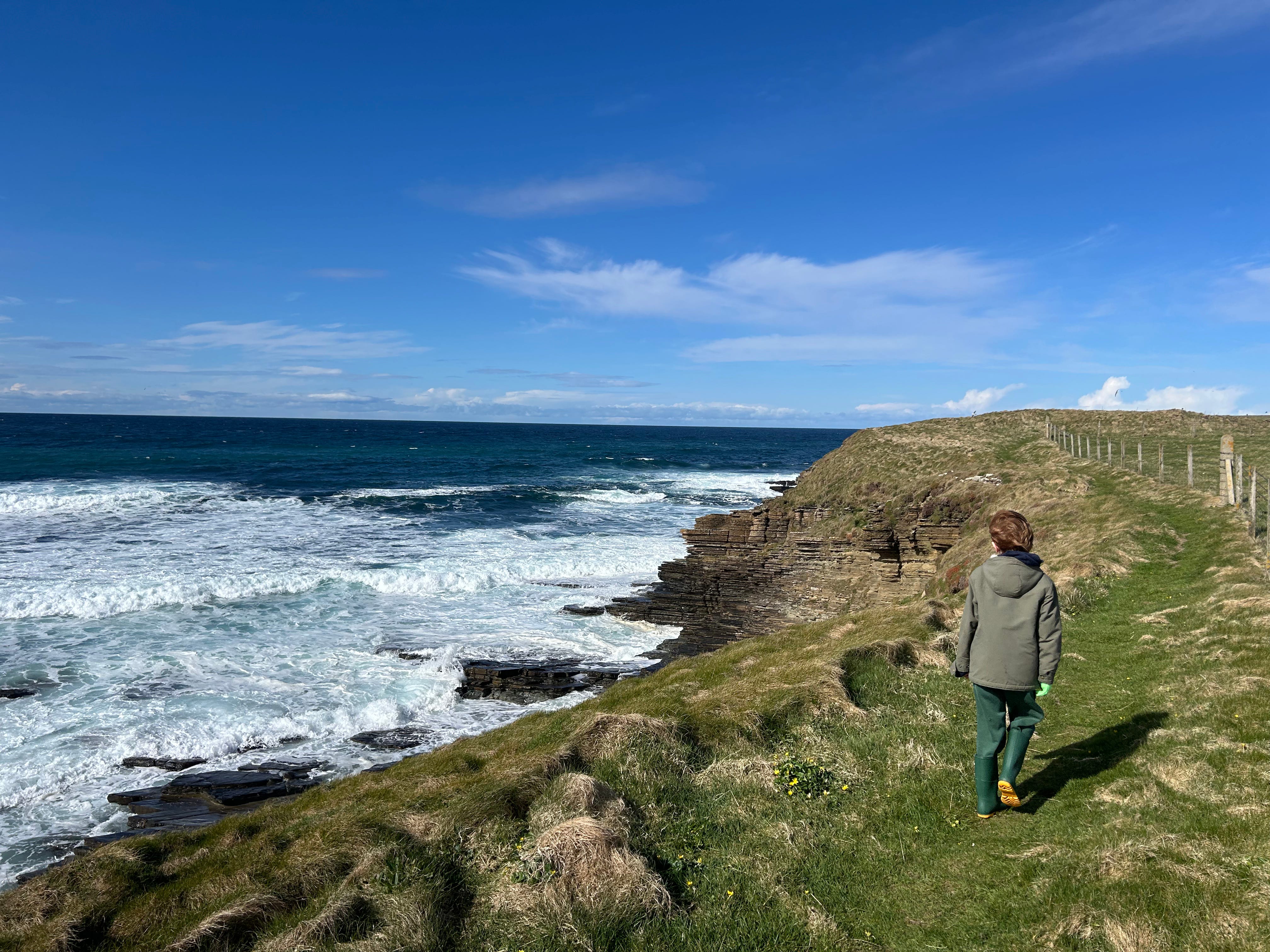
It’s not just animals who utilise the seaweed. The farm was historically allotted one sixth of the ware from Skaill for use on the land. From 1780 to 1830, Orkney’s economy was dominated by the kelp-making industry, when seaweed was burned and exported for an ingredient in glass and soap making. I have childhood recollections from the 1980s of tangles dragged up to dry above the high water line here at Skaill. Now, in 2025, there are a growing number of scientists and businesses experimenting with seaweed for uses including food, fertiliser and carbon sequestering, reviving the old knowledge. I have written about it all in my forthcoming book.
Seaweed has a reputation as something unpleasant - a ‘weed’, a byword for unpleasant smelliness, associated with poverty, something people would eat only when desperate. This idea is caused in part by the smell of rotting ware. Stormcast seaweed is quite different to the living, heldfast seaweed which is found lower down the shore and barely smells - just a fresh scent of the sea - and at high tide dances in the water. But the stormcast seaweed shouldn’t be seen as an eyesore, or a nose sore. As we have seen in our morning’s walk, ware is an important habitat and a biodiverse system of its own.
Looking forward to your book!
I’m a bit seaweed obsessed, and love to photograph what I find on the beach in Atlantic Canada, where I live.
Would love to immerse myself in studying it, but for the time being, I enjoy the sensuous, visual beauty and the scent of seaweeds.
I’m drawn to your words and am listening to The Instant, on audio book. In fact, I’m loving it so much. I just bought a hard copy of it.
Having grown up by the ocean off the Atlantic coast, l my family on my father’s side were mostly fishermen.
The ocean is in my bloodstream, always drawn to it, it’s always summoning me back to it.
A great big thank you for sharing a piece of your world here. Your words feel like home, a reflection on the other side of the big Atlantic pool..
Enjoyed this, Amy! Some years ago while I was a student I spent two summers volunteering on a farm in Northern Norway, where seaweed gathered from the nearby coastline was used as fertiliser. I've been interested in seaweed ever since!
Looking forward to the forthcoming book!